

What Makes a Vehicle Qualified for PDR And Auto Hail Repairs After a Hailstorm?
- WGAS SEO
- Dec 19, 2025
- 7 min read

Key Takeaways
A vehicle becomes an ideal candidate for Paintless Dent Repair (PDR) when the paint remains fully intact, and the metal has not overstretched under the force of hail.
Dent shape, depth, metal flexibility, and panel accessibility all influence whether the repair can be completed successfully.
Early inspections support accurate insurance documentation and prevent long-term metal tension from affecting repair quality.
Customers in hail-prone areas, including Arvada, CO, benefit from quick assessments and organized repair planning.
Our team adds further value with complimentary loaner vehicles, a zero-deductible policy on qualifying hail claims, and a lifetime warranty on all completed repairs.
After a hailstorm, many customers reach out with the same question: “Is my vehicle a good candidate for Paintless Dent Repair?” Hail can create a wide range of dent types, from light surface dimples to deep impressions that alter the vehicle’s contours. Because of this, eligibility for PDR is not based on the number of dents but rather on the condition of the metal and the paint.
Our goal at International PDR is to make the evaluation process clear, simple, and informative. We want customers to understand what technicians look for, how we determine repair feasibility, and why certain vehicles can be restored more easily than others. This knowledge helps set expectations and supports a smoother experience for customers seeking auto hail repairs after storm season.
Why PDR Remains the Standard for Restoring Hail-Damaged Vehicles
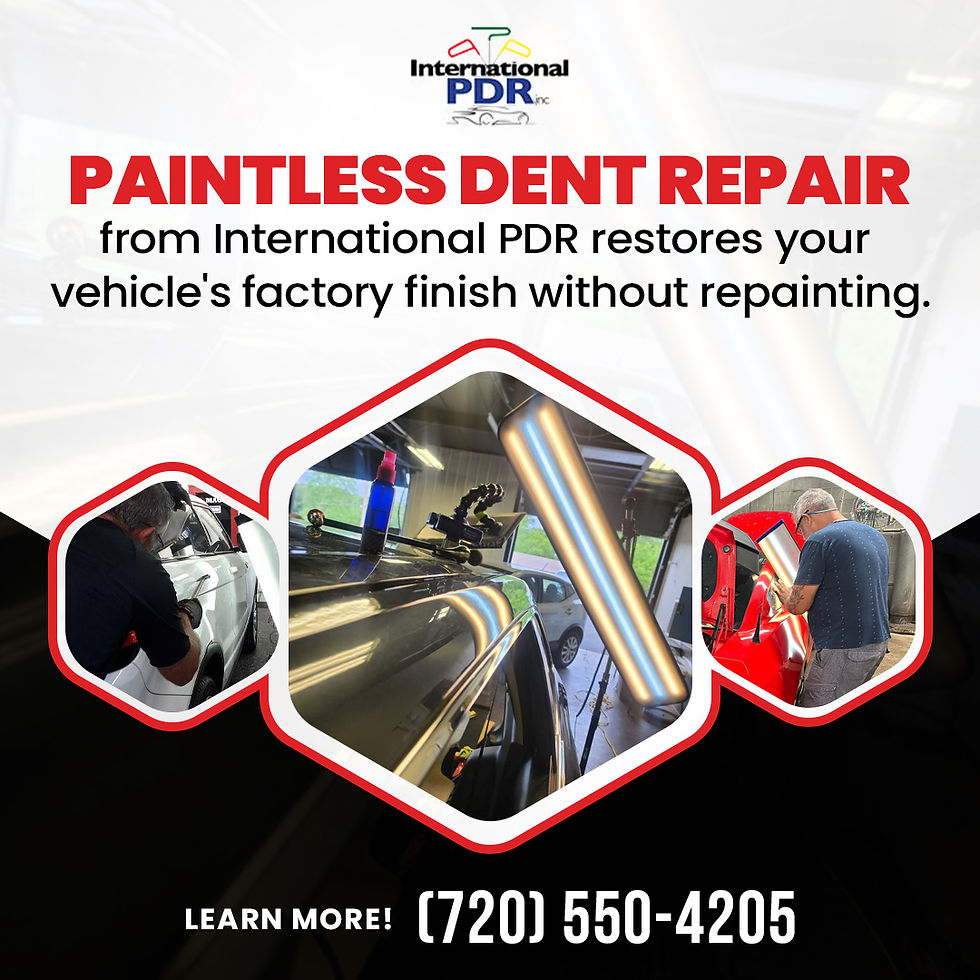
Paintless dent repair has become the trusted repair method among insurance companies, manufacturers, and dealerships because it preserves the original condition of the vehicle. Instead of sanding, filling, or repainting, PDR uses controlled pressure from behind the panel to restore the metal. The factory finish remains untouched, which keeps the vehicle’s long-term value intact.
For customers searching for auto repairs for hail damage, this method offers several important advantages. First, it avoids mismatched paint, blending issues, or changes in texture that can occur with traditional bodywork. Second, it maintains the structural integrity of the panel by avoiding unnecessary grinding or cutting. Third, it is environmentally responsible because it does not require solvents, fillers, or chemical compounds.
However, PDR success depends on one essential factor: paint flexibility. If the paint can move with the metal without cracking, the dent can often be corrected cleanly. If the paint is damaged or brittle, traditional options may be needed. This is why the inspection phase is so critical for customers seeking hail damage repair in Arvada, CO, especially after severe storms.
In most cases, when the paint coating is flexible and undamaged, the repair process is smooth and offers results that align with manufacturer standards.
Conditions We Review When Evaluating PDR Eligibility
Every evaluation begins with a detailed visual analysis. Our technicians at International PDR use specialized lighting to highlight shadows, reflections, and contours that reveal the true shape of each dent. This helps determine whether the metal can return to its original form without compromising the paint.
The following factors are always reviewed during evaluations:
Paint Integrity: Paint must remain unbroken for PDR to be feasible. Even a small crack can prevent successful restoration.
Depth and Sharpness of Dents: Shallow dents respond very well. Deep dents require more technique but may still qualify.
Distribution Pattern: Hail often creates dense clusters across flat surfaces. These patterns often indicate good repair potential for auto hail damage repairs in Arvada.
Structural Areas vs. Open Panels: Open panels provide more access. Reinforced sections may restrict tool movement.
Previous Bodywork: Repainted or heavily repaired panels may have reduced flexibility.
Vehicles showing widespread denting can still be excellent PDR candidates. Clusters across the hood, roof, and trunk often respond effectively because those areas offer open access points and smooth metal movement. Reinforced edges or body lines may require additional steps, but many still qualify once evaluated.
Why Paint Condition Determines Repair Success
Paint condition is one of the strongest indicators of whether PDR will work. The paint must stretch and return with the metal. If it has even minor fractures, the repair process may cause peeling or distortion.
During our inspection, we use high-grade inspection lights to detect tiny cracks or stress marks that may not be visible outdoors. These checks allow us to determine whether the vehicle’s environment, age, or prior repairs have weakened the paint.
Original Paint vs. Repainted Panels
Factory paint typically performs best. Manufacturers apply paint in controlled environments with uniform thickness and strong bonding to the metal. These qualities allow the finish to flex and return as the dent is corrected.
Repainted surfaces often behave differently. They may be thicker, uneven, or applied without the same temperature-controlled curing. Because of this, repainted areas may crack under pressure. For customers seeking auto hail repair in Arvada, CO, vehicles with original paint generally achieve the most consistent results.
When the paint checks out, the chances of achieving a near-perfect restoration improve considerably.
How Metal Type and Flexibility Influence Outcomes
Vehicle panels are made from varying alloys. Each one responds differently to pressure, temperature, and stretching:
Steel Panels
Steel has a strong memory and usually returns smoothly with proper toolwork. Most steel vehicles qualify for PDR unless the dent is extremely sharp.
Aluminum Panels
Aluminum is lighter but less flexible. It requires refined technique and may resist movement if the dent is deep or stretched. However, many aluminum vehicles still qualify once paint integrity is confirmed.
High-strength steel zones
Certain areas of modern vehicles use stronger steel to protect passengers. These reinforced areas may respond differently and require slower, more controlled movements.
At International PDR, we examine metal memory, the dent shape, and the impact direction to decide whether PDR is safe. Rounded dents often indicate that the metal can move cleanly. Sharp dents may indicate stretched metal, requiring additional evaluation.
By understanding material behavior, we make sure that repairs are precise and long-lasting for customers needing auto hail damage repairs after major storms.
How Dent Size, Shape, and Location Affect Repair Potential
Not all dents behave the same. Size, shape, and location all matter in determining whether a dent can be restored.
Small to Medium Dents
These are the most common during hail season. They typically follow a smooth curve and respond well to PDR.
Large Dents
Larger dents may still qualify if the paint is intact and the metal has not folded.
Shallow vs. Deep Dents
Shallow dents repair quickly. Deeper dents require more time and technique, but can still produce excellent results if the damage is not sharp.
Dent Spacing and Density
Vehicles hit by heavy hail often show hundreds of small dents. Surprisingly, these usually qualify more easily because the metal has not been overstretched.
Impact Zones
Flat surfaces respond best. Edges, corners, and body lines may require extra time, but many are still repairable.
This detailed review helps us determine which dents qualify for restoration and how to plan the repair efficiently for customers needing auto hail damage repair in and around Arvada.
How Panel Access Affects PDR Repairs
PDR requires access behind the dent. Without access, tools cannot apply controlled pressure.
Panels with Easy Access
Hoods
Roofs
Doors
Trunks
These areas usually allow direct access, which supports fast and efficient work.
Panels with Limited Access
Inner bracing
Intrusion beams
Tight corners
Double-walled areas
These areas are still repairable in many cases, but require more time and specialized tool paths.
During inspections, we map the inside of each panel to identify access points. If a dent is reachable without compromising structural components, we proceed. When access is limited, we explain the process and provide customers with realistic timelines.
When Extensive Hail Damage Still Qualifies for PDR
Many people assume severe damage means PDR is impossible. In reality, extensive denting can still be repaired as long as:
The metal has not torn
The paint has not fractured
The impact did not cause panel distortion
Cars covered in hundreds of dents often remain perfect candidates for auto hail damage repair using PDR. Clusters of small dents typically indicate that the metal preserved its natural memory. This allows for accurate reshaping, even across large surface areas.
Our team of technicians at International PDR evaluates whether the panel can move without cracking the paint. If conditions are favorable, PDR restores even heavily damaged vehicles to a clean, uniform finish.
Why Prompt Inspections Support Better Repair Results
Time plays an important role in PDR success. Delaying inspections can introduce new challenges:
Metal Fatigue: Weather cycles can stiffen the metal, making it less responsive.
Heat Expansion: Repeated heating from sunlight can affect the shape of dents.
Insurance Delays: Adjusters need accurate, timely documentation. Early evaluations help avoid supplemental claims and delays.
Customers in hail-heavy regions often benefit from rapid evaluations after storms. Fast action guarantees better repair outcomes, especially for those seeking hail damage repair during peak season.
At International PDR, we guide customers through the entire claim process, communicate with adjusters, handle supplements, and make sure that no damage is overlooked.
How Our Evaluation Process Provides Accurate Repair Planning
Our evaluation system is structured, detailed, and designed for accuracy. Each inspection involves:
Reviewing paint condition
Checking metal flexibility
Mapping dent distribution
Identifying internal bracing
Evaluating access points
Confirming insurance documentation
Once the evaluation is complete, we provide a clear explanation of what qualifies for PDR and what customers should expect from us at International PDR. This transparency removes surprises and supports smooth scheduling. If the vehicle meets PDR criteria, we move directly into claim coordination, which speeds up repair start times.
Additional Advantages Customers Receive When Choosing Our Team
Vehicles that qualify for PDR at our shop receive more than technical restoration. We provide a full customer support system:
$0 Deductible on Qualifying Hail Claims: No out-of-pocket expenses for approved hail repairs.
Complimentary Pick-Up and Drop-Off: We bring a loaner vehicle directly to the customer when available.
Access to 2024 Loaner Vehicles: Transportation continues while the car is being restored. We also offer complimentary pick-up and drop-off to keep the process convenient.
Lifetime Warranty: Once the repair is complete, the restored areas remain stable for the life of the vehicle.
Insurance Support: We handle all communication with the insurance provider, including supplements for overlooked damage.
Referral Rewards: Customers earn cashback on successful referrals.
Trusted Paintless Dent Repair Specialists: Our methods align with industry standards and manufacturer expectations.
These advantages help streamline the repair process from start to finish.
What Customers Are Saying
“Great place to repair your car because of the hail damage. 100% recommended. Fast and friendly.” — Claudia Osorio
“Exceptional service! I didn’t have to worry about a thing and they took care of anything!” — Maribel Ortega
“Friendly staff and good turn around time. They do great work, and will work with your insurance company to make sure they get as much coverage as possible! Definitely recommend their services!!” — Don Kelly
“Amazing dent repair company, fast, responsible, and great work. Will definitely use again…..” — Kensr Nel
These reviews highlight the qualities customers appreciate most: speed, communication, thoroughness, and consistent quality.

Contact International PDR for Professional Auto Hail Damage Repair Services
Determining whether a vehicle qualifies for paintless dent repair requires careful evaluation of paint condition, dent structure, metal behavior, and panel access. When these factors align, PDR offers a highly effective, factory-preserving repair solution. To schedule an inspection or request professional hail damage repair services in Arvada, CO, contact us today at (720) 550-4205 or Contact@InternationalPDR.com.


Comments